Blast-Resistant Module Construction Specifications: What Sets Hunter Apart
Why Construction Standards Matter in Blast-Resistant Modules
Blast-resistant modules (BRMs), also known as blast-resistant buildings, are more than shelters; they are engineered environments designed to protect workers in high-risk industrial settings such as petrochemical plants, refineries, and manufacturing sites. The strength, safety, and comfort of these facilities depend on their construction specifications. At Hunter Onsite, every BRM is manufactured to exceed industry expectations, ensuring both compliance and peace of mind.
Below, we break down the standard specifications that come with every Hunter Onsite blast-resistant module.
Exterior & Interior Construction Specifications
|
|
|
| Base Structure |
Steel structure with HSS perimeter tubes, HSS joists @ 24" O.C., flat plate base |
| Siding |
HSS columns with crimped profile plate |
| Roof |
Perimeter HSS tubes, Cee joists @ 24" O.C., flat plate roof with slope |
| Exterior Doors |
36” x 80” stainless reinforced, 8.0 PSI blast rated, heavy-duty hinges, keyed latchset, hydraulic closer, panic push bar, drip cap |
| Floor |
-1/8" plywood Sturd-I-Floor over joists, finished with commercial-grade tile |
| Walls |
Steel stud framing (3 5/8" x 20 ga. @ 16" O.C.), R-19 fiberglass + semi-rigid insulation (R-25.2) |
| Ceilings |
7’11” height, acoustical mineral fiber panels (2’ x 2’ grid, CertainTeed “Baroque”), R-38 insulation |
Safety & Utilities
|
|
|
| Interior Doors |
36” x 80” solid core, metal frame, privacy or passage latchset |
| Communications Cabinet |
Hinged cabinet with surge protection, cross-connect wiring, CAT 6 patch panel |
| Electrical |
Class I, Division 2 exterior classification; general purpose interior; 120/240VAC distribution |
| Lighting |
LED flat panels with dimming drivers and emergency battery backup |
| Floor |
-1/8" plywood Sturd-I-Floor over joists, finished with commercial-grade tile |
| Fire Protection |
Smoke detectors, semi-recessed fire extinguishers, HVAC shutdown integration |
| HVAC |
R-410A system with redundancy, humidity control, and barometric damper |
Insulation R-Values Quick Reference
|
|
|
|
| Perimeter Walls |
3" closed-cell spray foam |
R-20 |
| Interior Partition Walls |
Fiberglass insulation (Kraft |
R-13 |
| Combined Perimeter (Fiberglass + Board) |
Fiberglass R-19 + Semi-rigid Board 1.5" |
R-25.2 |
| Ceiling |
5.14" closed-cell spray foam |
R-38 |
Built-In Safety Compliance
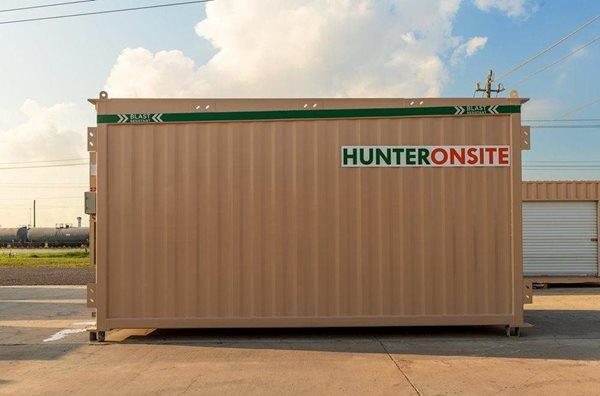
Hunter Onsite’s BRBs are designed in accordance with OSHA requirements and industry standards like API RP 752 and 753. From structural resilience to integrated fire and gas detection, every element is engineered with worker protection as the top priority.
Conclusion
When it comes to blast-resistant modules, specifications matter. Hunter Onsite delivers standardized construction that not only complies with regulations but also ensures safety, comfort, and long-term durability. With every module, you gain more than a structure—you gain peace of mind.
Frequently Asked Questions About Blast-Resistant Module Construction
What does “blast rating” mean in a BRM door?
It refers to the door’s tested ability to withstand specific blast pressures, measured in PSI. Hunter Onsite doors are rated to 8.0 PSI.
Are Hunter Onsite BRMs customizable?
Yes. While all units come standard with the specifications above, some layouts, finishes, and accessories can be tailored to meet site-specific requirements. Contact Hunter Onsite for more details.
How are BRMs delivered and installed?
Modules are manufactured off-site, transported to your location, and set in place with lifting points and grounding pads. Foundation design is the client’s responsibility, with Hunter providing calculation data as needed.
Do BRMs meet fire protection standards?
Yes. Each building includes smoke detectors, extinguishers, and integrated systems to shut down HVAC in case of fire or gas detection.